Text

Handwoven Modern and Traditional Reed Baskets by Rachel Starry
Welcome to Turquoise and Twill, where you'll find a gallery of my previous work as well as previews of works-in-progress and other basket-related fun. To see what I currently have in stock, check out my Etsy shop, TurquoiseAndTwill!
Showing posts with label historical baskets. Show all posts

Tuesday, March 24, 2015

Traditional Choctaw Basketry


One of the most interesting traditional basket designs I have ever encountered is the pointed-bottom wall pouch that is historically associated with the Choctaw tribes of the southeastern United States. Today there are three nations of Choctaw Native Americans, living in Oklahoma, Louisiana, and Mississippi. These tribes have a rich history of basket-weaving, and several distinct styles of Choctaw baskets exist. 

Traditional Choctaw baskets were (and still are) woven from river cane, which is harvested and then processed into strands of cane fibers. These fibers were sometimes dyed in shades of black/brown, red, and yellow, originally using plant-based dyes and pastes from species native to the Southeast, such as black walnut, red oak, and black gum trees. Today most Choctaw baskets are made using commercial dyes, which I also use to dye the reed for my baskets (to find out more about my dying process, check out the tutorial I posted recently). 

Large wall pouch basket (front)
Large Wall Pouch (front)
Large wall pouch basket (back)
Large Wall Pouch (back)


I found a pattern for the type of basket known as taposhake chufa (“pointed basket”) in the Choctaw language, and decided to make a few in different sizes and colors. I especially love how the larger one turned out (images above). It’s such an eye-catching shape, and because of the weaving method, the colored reed runs horizontally on one side and vertically on the other in the lower part of the basket. Knowing that this style of basket has a long and interesting history makes it even more exciting, and I hope to make more like it in the future!

"Pointed" basket (from ChoctawNationCulture)

Other styles of Choctaw baskets include pack baskets, “elbow” baskets (named for their shape), and lidded baskets. One of the ways to distinguish Choctaw baskets from other river cane baskets is by their distinctive wrapped rim and handles, which you can see on some of the baskets shown here. Another distinctive feature of Choctaw basket design is that many baskets are double-walled, with different designs visible on the inner and outer walls, and all of the Choctaw baskets that I've seen are plaited (plaiting is a weaving method where the horizontal and vertical elements are spaced evenly). 


Choctaw elbow basket

Elbow basket (from AccessGenealogy)


For more information on Choctaw history and culture, especially the tribes’ rich basket-weaving traditions, see Culture and Customs of the Choctaw Indians, by Donna Akers (2013), as well as the websites listed below.

Thursday, March 19, 2015

Repairing an Antique Basket

A friend gave me a basket a while back that needed repairs to its base and handle, where the reed had become brittle with age and broken in a few places. It was an antique Norwegian basket that had originally belonged to her grandmother, and she asked if I would be able to repair it.

Since the basket was woven with a fairly standard size of reed (#2 round according to my measurements), I was able to stain some reed and weave small pieces alongside the old, broken stakes to secure the brittle areas. The patching was successful in strengthening the basket and is a bit more inconspicuous than the previous method of repair (an old shoelace woven in alongside the broken stakes). Take a look at the before-and-after photos to see the difference the repairs made! Hopefully they will help the basket survive so that many more generations will be able to appreciate its simple beauty.

Bottom (before)
Bottom (after)


Handle, left (before)
Handle, right (before)
Handle (after)

Sunday, February 22, 2015

Shaker Baskets - A Brief History

The Shakers were a splinter sect of Quakers that was formed in the 18th century in England. Several Shaker communities were founded in the American colonies in the late 18th and early 19th centuries, most famously at Mount Lebanon, NY. The Shakers were known for their simple lifestyles and religious beliefs, being a pacifist society in which men and women shared equal responsibility in the church hierarchy. They are also known for their architecture, furniture, and crafts, among which are the many styles of baskets that can be found today in museums and private collections.

http://www.journalofantiques.com/images30/f2.JPG
Authentic Shaker Cheese Baskets (www.journalofantiques.com)
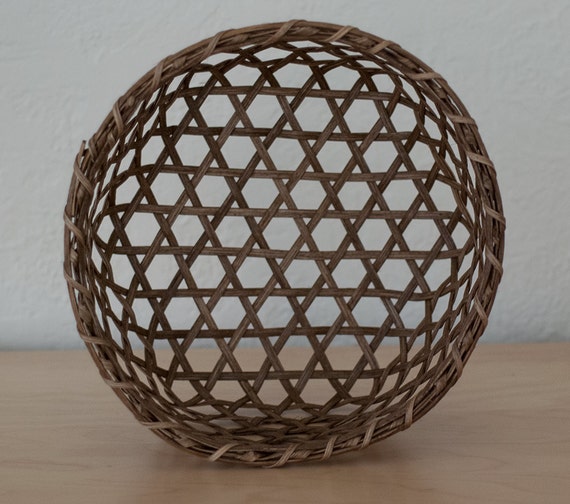
One of my favorite baskets to make is in the style known as the Shaker cheese basket. Historically, this type of basket was used in the cheese production process to drain the curds and separate them from the whey. It is made using a traditional hexagonal weave, which can be manipulated to create many variations in shape and size. I prefer to make them in a form that begins with a hexagonal base and rises with straight walls to a round rim, either with or without a handle.

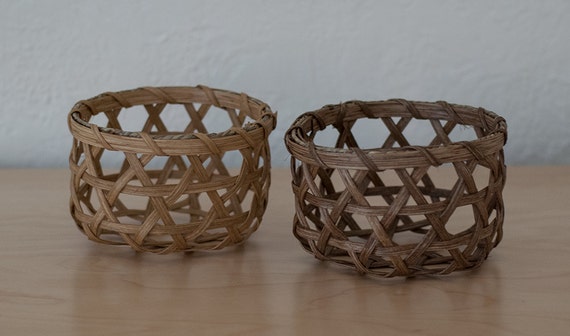
In the image above, you can see that a pair of runners has been lashed to the bottom of each basket; these were used to hold the baskets to a cheese ladder. Below are examples of two different sizes of Shaker cheese baskets that I've made.

Handwoven Shaker Cheese Basket - Traditional Early American Hexagonal Weave Basket - Dark Walnut Brown Stain
Shaker Cheese Basket
Handwoven Miniature Shaker Cheese Basket - Traditional Early American Hexagonal Weave Basket - Light Golden Oak and Dark Walnut Brown Stain
Miniature Shaker Cheese Baskets
Several other styles of Shaker baskets exist, including types that were used for work in the field (like wash baskets and fruit baskets) and more decorative types used within the home (known as "fancy" baskets, often in a shape known as a Shaker cat's head basket). For more information on Shaker baskets, check out Shaker Baskets (1988) by Martha Wetherbee and Nathan Taylor, or Basketry: The Shaker Tradition (1990) by John McGuire. I've also included a list of several websites at the end of this post that provide more information and pictures.

http://www.journalofantiques.com/images30/f1.JPG
Shaker Wash Baskets (www.journalofantiques.com)
https://s-media-cache-ak0.pinimg.com/236x/ec/47/d2/ec47d2f86fe49599a135922d589a3f68.jpg
Shaker Herb Drying Basket (www.pinterest.com)
Two distinctive features of authentic Shaker baskets are their rims and handles, which are often carved from the same piece of wood and lashed together with the same brown ash or white oak splint in which the rest of the basket is woven. These baskets display incredibly fine craftsmanship using hand-split and hand-carved local materials and are beautiful examples of early American basketry!

http://www.journalofantiques.com/images30/f12.JPG
Typical Shaker Handle and Rim Design (www.journalofantiques.com)

http://shakerworkshops.com/resources/who-are-the-shakers/shaker-fancy-baskets/
http://shakerheritage.wordpress.com/2012/03/28/the-shaker-basket-making-tradition/
http://www.journalofantiques.com/Jan04/featurejan04.htm

Saturday, February 21, 2015

The Shop Doors Open!

This is it - the inaugural post!  After a few weeks of intense preparations, which included compiling lists of articles that compile lists of articles on everything you could possibly want to know about selling on Etsy, I've finally opened the doors of my Etsy shop, TurquoiseAndTwill.  A few listings went up today, including the large and small versions of my take on the traditional Shaker cheese basket (a popular early American basket that uses hexagonal weave).

There's still so much to be done, but I have been busy on Pinterest where I've organized several boards on topics like basket storage ideas, decorating with baskets, gift basket inspiration, historical baskets, and eclectic home decor. I'm hoping to use this blog - and, by extension, my pinboards and Facebook page - as a place to showcase my past and current work as well as give insight into my creative process, share interesting tidbits on the history of basket-making, and post basket patterns and tutorials. It's a daunting task to be setting out on, but I'm hopeful that things will start coming together soon!